Narrative Feature Extraction
📖 Browse the documentation book →
The full documentation — scoping review, annotation format, pipeline, corpus, the review
paper with figures, and the interactive segment browser — is published as a book at
canlab.github.io/narrative_feature_annotations.
It is the recommended entry point. (Build/deploy notes: docs/DEPLOYING.md.)
🗺️ Feature map — all 103 annotation channels at a glance
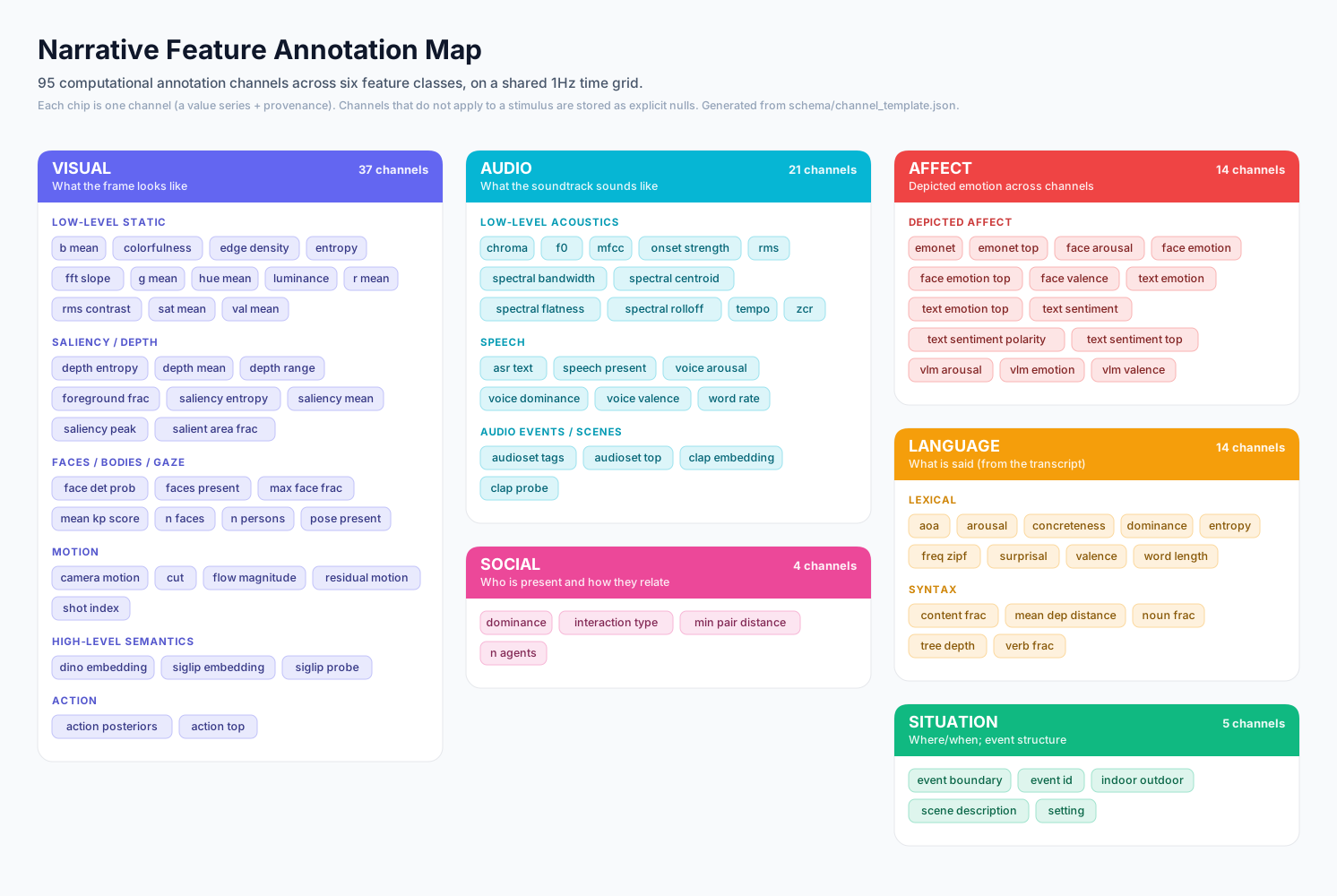
A map of every feature and its hierarchical organization. The source is an editable
SVG (open/recolor in PowerPoint, Illustrator, or Inkscape);
regenerate with python3 tools/build_feature_map.py.
Infrastructure for producing second-by-second computational annotations of movies and audio stories across the full range of stimulus, perceptual, linguistic, social, situational, and affective features — for use in cognitive science and naturalistic-neuroimaging research.
A human supplies a movie or story; the pipeline returns a hierarchical, semantically organized, time-resolved set of annotations from a curated set of best-in-class models. Annotations that do not apply to a given stimulus (e.g. visual features for an audio-only story) are returned as explicit nulls (NaN). The output reserves space for later human annotations and ships with a lightweight MATLAB reader.
Project phases
| Phase | Goal | Status |
|---|---|---|
| 1. Scoping review | Survey computational annotation tools across all feature classes; organize in a semantic hierarchy; recommend best-in-class vs redundant features. | ✅ Draft complete — see docs/scoping_review/ |
| 2. Pipeline build | Select final feature/model set (with human input); deploy models locally or via API; produce hierarchical second-by-second annotations + MATLAB reader. | ✅ 24 extractors across all classes; constant-shape output; see docs/design/PHASE2_STATUS.md |
| 3. Corpus annotation | Assemble movies/stories (user-supplied + sourced); run annotations across the whole corpus. | ✅ manifest + resumable batch runner; 107 stimuli annotated (movies, films, 29 spoken stories, a text story). docs/design/PHASE3_CORPUS.md |
| 4. Analysis & dissemination | MATLAB analysis across corpus; review paper; interactive web search interface; experimental-design / stimulus-selection tool. | ✅ corpus reader, synced viewer, correlation/PCA/network, design tool, web search, draft review paper. docs/design/PHASE4_ANALYSIS.md |
Repository layout
docs/
  scoping_review/      # Phase 1 output: the hierarchical scoping review
  design/              # plans, schema design, deployment feasibility
schema/                # annotation output format (spec + JSON schema + example)
src/nfe/               # the pipeline package
  base.py              #   types, common-grid TimeGrid, resampler
  ingest.py            #   PyAV decode + audio extraction
  emit.py              #   HDF5 + JSON-sidecar writer
  pipeline.py, run.py  #   orchestration + CLI
  extractors/          #   one module per feature pass
matlab/                # MATLAB reader (readAnnotations / getFeature / featuresToTimetable)
data/
  movies/              # input movies (spacetop/ = lab stimuli; open/ = CC-BY test films)
  stories/             # input audio stories
annotations/
  corpus/<id>/         # corpus derivatives: <id>.h5 + <id>.manifest.json per stimulus
                       #   + corpus_index.csv (batch status)
analysis/
  figures/             # generated analysis figures
  corpus_stats.json    # corpus summary numbers the docs cite
  web/                 # interactive segment-search app
tools/                 # helper scripts (manifest, template, search index, refresh)
Quickstart (Phase 2 pipeline)
python3 -m venv .venv && .venv/bin/pip install -r requirements.txt
PYTHONPATH=src .venv/bin/python -m nfe.run data/movies/open/BigBuckBunny.mp4 --rate 1.0
See docs/design/PHASE2_STATUS.md for what runs today and what’s next.
Design principles
- Common time grid. Every feature has a native rate (frame, sub-second, per-second, per-utterance); all are resampled onto a configurable common grid (default 1 Hz) with native-rate metadata preserved.
- Explicit nulls. Inapplicable annotations are
NaN, never silently omitted, so downstream analysis can distinguish “not measured” from “measured zero.” - Hierarchical + readable. Output is organized by the semantic hierarchy in
docs/scoping_review/so a human can read it and a program can traverse it. - Local-first. Prefer open, locally deployable models; fall back to hosted large models only where they are clearly superior and irreplaceable.
- Reproducible provenance. Each feature records the model name, version, and parameters that produced it.
Start here
docs/CONTENTS.md— full guide to the folder, tools, datasets, the extracted derivatives, and how to load / view / inspect them.docs/walkthrough.m— runnable MATLAB tour of the common operations.docs/REVIEW_PAPER.md— draft review: the models/algorithms and the empirical structure of the annotation space across the corpus.docs/ADDING_MOVIES.md— how to add movies/stories and refresh the whole dataset (annotations, search index, figures, and the corpus-specific doc numbers).
Key documents
- Scoping review (Phase 1 output):
docs/scoping_review/— 146 tools across 15 feature subclasses, the semantic hierarchy, redundancy analysis, and best-in-class recommendations. - Annotation output format:
docs/design/ANNOTATION_FORMAT.md— authoritative v0.2 spec (HDF5 canonical + readable JSON sidecar; common grid; explicit nulls; reserved human-annotation slots; MATLAB reader interface).schema/annotation_schema.jsonis the v0.1 pure-JSON profile used for small/demo files, andmatlab/*.mis the reference reader for that profile. - Phase 2 core-set freeze sheet:
docs/design/PHASE2_CORE_SET_PROPOSAL.md— fillable decision doc; sign-off freezes the Phase 2 build scope. - Deployment feasibility:
docs/design/DEPLOYMENT_FEASIBILITY.md. - Full plan:
docs/design/IMPLEMENTATION_PLAN.md.